Irish grandma names carry the warmth of a family kitchen and the long memory of a country that treasures its stories. Choosing one is a lovely way to honor a grandmother’s roots, whether she grew up in Galway, Boston, Sydney, or Toronto. Some families want an authentic Irish word, while others prefer a gentle nickname that feels like home the moment a toddler says it. Either way, the right name can become part of a family’s story for generations.
This guide explains what each kind of name really is, so you can choose with confidence. You will find documented Irish grandmother terms, English and Irish English family titles, affectionate nicknames, classic Irish female names, historical and legendary names, and nature-inspired ideas. Meanings and pronunciation notes are included where sources support them, and invented nicknames are clearly labeled so they are never mistaken for Irish words.
What Is the Irish Word for Grandma?
The standard Irish word for grandmother is seanmháthair, which literally means “old mother.” In everyday family life, children more often use the familiar words mamó or móraí, while seanmháthair is the formal term used when talking about a grandmother rather than speaking to her.
The Irish language dictionary from Foras na Gaeilge lists seanmháthair, máthair mhór, and máthair chríonna as translations of grandmother. The table below separates formal terms from familiar ones. Pronunciations are approximate, and dialects differ, so listen to audio before using a word in a formal setting.
| Irish term | English meaning | Pronunciation | Usage or context |
|---|---|---|---|
| Seanmháthair | Grandmother, literally “old mother” | SHAN WAW hir (approximate) | The formal, standard term, usually not used when addressing her directly |
| Mamó | Grandma, granny | ma MOH (approximate) | Familiar and affectionate, typically used by children |
| Móraí | Grandma, granny | MOR ee (approximate) | Familiar and affectionate, an alternative to mamó |
| Máthair mhór | Literally “big mother” | Check audio for your dialect | A descriptive term listed in the dictionary |
| Máthair chríonna | Literally “wise mother” | Check audio for your dialect | A descriptive term listed in the dictionary |
| Sinseanmháthair | Great grandmother | SHIN SHAN WAW hir (approximate) | The usual form for a great grandmother |
Irish Grandma Titles and Nicknames
Irish grandma titles fall into three groups. Some are genuine Irish-language words, some are English family titles common in Irish homes, and others are nicknames families invent for fun. Keeping these groups separate helps you choose a title that is accurate and fits your family’s style.
Traditional Gaelic Titles
Traditional Gaelic titles are the documented Irish words for grandmother, and all six are in the table above. They are counted there as entries 1 to 6, so they are not repeated in a list here.
You may also see mamó written as maimeó, which sources describe as another spelling of the same familiar word. Because it is a variant rather than a separate term, it is not counted as its own entry. Children often address their grandmother as mhamó, the form the word takes when spoken to directly. Only six distinct terms could be supported, so this guide does not invent more Irish words to reach a bigger number.
Irish English Blended Titles
These are English family titles that are widely used in Irish homes and across the English-speaking world. None of them is a Gaelic word, so they should not be presented as Irish language terms.
- Nana: A friendly, easy title that suits an affectionate grandmother.
- Nan: A short everyday form that feels casual and warm.
- Nanny: A gentle title that small children tend to say easily.
- Granny: A cozy, classic title with a storybook feel.
- Gran: A brisk, practical title for a busy family.
- Grandma: The plain, universal choice that everyone understands.
- Grandmother: The full formal title, good for letters and ceremonies.
- Grandmama: A softer, slightly old-fashioned variation with a dignified tone.
- Grammy: A sweet, rounded sound that many grandchildren enjoy.
- Gammy: A playful, informal pet title.
- Gigi: A stylish, modern-sounding choice for a younger grandmother.
- Mimi: A light, breezy title that toddlers can manage.
- Nonny: A tender, singsong title.
- Meemaw: A homey title with a warm, cuddly sound.
- Grams: A quick, casual option for older grandchildren.
- Gramsie: A cheerful pet form that adds extra warmth.
- Nini: A baby-friendly sound that is simple to repeat.
- Lolly: A bright, playful title with a sweet ring.
- Mimsy: A whimsical option for a grandmother with a light touch.
- Gaga: A fun title that toddlers often find easy to say.
- Glamma: A cheeky blend of “glamorous” and “grandma” for a stylish grandmother.
- Mawmaw: A soft, rounded title with a comforting sound.
Cute Irish Grandma Nicknames
Every name in this section is a family created or Irish-inspired nickname. They draw on Irish symbols, places, rivers, landscapes, music, festivals, and folklore, but they are not traditional titles and do not carry Irish-language meaning as nicknames.
- Shamrock: Ireland’s best-known national symbol, used here as a playful pet name.
- Clover: A lucky green plant that makes a gentle, affectionate nickname.
- Blarney: A nod to the Irish gift of persuasive talk, for a grandmother who loves a chat.
- Claddagh: Named after the traditional Irish ring that symbolizes love, loyalty, and friendship.
- Emerald: Evokes the green landscape so often linked with Ireland.
- Celtic: A broad heritage nod for families proud of their roots.
- Erin: A poetic name for Ireland, used here as a tender nickname.
- Hibernia: The old Latin name for Ireland, grand and a little theatrical.
- Fiddle: Inspired by traditional Irish music sessions.
- Bodhrán: Named for the Irish frame drum, a fit for a lively, rhythmic grandmother.
- Harp: A national emblem of Ireland, graceful and musical.
- Ceilidh: Borrowed from the Irish gathering of music and dance, for a grandmother who loves a party.
- Craic: Irish English for good fun and good conversation.
- Cuppa: A cozy nod to endless cups of tea.
- Seanchaí: The Irish word for a traditional storyteller, ideal for the keeper of family tales.
- Selkie: A seal woman from coastal folklore, mysterious and gentle.
- Pooka: A shape-shifting spirit from Irish folklore, cheeky and fun.
- Banshee: A figure from Irish folklore, used with a wink to refer to a grandmother with a sense of humor.
- Leprechaun: A famous figure in folklore, best for a playful, mischievous grandmother.
- Merrow: A mermaid of Irish folklore, soft and sea themed.
- Antrim: Named for County Antrim in Northern Ireland.
- Armagh: Named for the county and city in Northern Ireland with deep church history.
- Carlow: Named for County Carlow in the southeast.
- Cavan: Named for the inland county of Cavan.
- Clare: Named for County Clare on the west coast.
- Derry: Named for the city and county of Derry.
- Donegal: Named for the rugged northwestern county.
- Galway: Named for the western city and county.
- Kerry: Named for the scenic southwestern county.
- Kildare: Named for County Kildare in Leinster.
- Kilkenny: Named for the medieval city and county.
- Leitrim: Named for the quiet northwestern county.
- Limerick: Named for the city and county on the River Shannon.
- Mayo: Named for County Mayo in the west.
- Meath: Named for the county of Meath in the east.
- Sligo: Named for the northwestern county of Sligo.
- Tipperary: Named for the Munster county and its famous song.
- Waterford: Named for the southeastern city known for crystal.
- Wexford: Named for the southeastern county and its coast.
- Wicklow: Named for the county often called the Garden of Ireland.
- Tara: Named for the Hill of Tara in County Meath, long tied to Irish kingship.
- Dingle: Named for the Dingle Peninsula in County Kerry.
- Aran: Named for the Aran Islands off the coast of Galway.
- Burren: Named for the limestone landscape of County Clare.
- Connemara: Named for the wild and beautiful region of County Galway.
- Skellig: Named for the rocky islands off the Kerry coast.
- Howth: Named for the peninsula near Dublin.
- Killarney: Named for the Kerry town and its lakes.
- Moher: Named for the Cliffs of Moher in County Clare.
- Rosslare: Named for the port town in County Wexford.
- Achill: Named for Achill Island off County Mayo.
- Clifden: Named for the Connemara town on the Atlantic coast.
- Doolin: Named for the Clare village known for traditional music.
- Kinsale: Named for the harbor town in County Cork.
- Cobh: Named for the harbor town in County Cork.
- Glendalough: Named for the monastic valley in County Wicklow.
- Newgrange: Named for the ancient passage tomb in County Meath.
- Slane: Named for the village in Meath beside the River Boyne.
- Cashel: Named for the Rock of Cashel in County Tipperary.
- Bantry: Named for the bay and town in County Cork.
- Liffey: Named for the river that runs through Dublin.
- Corrib: Named for the river and lough at Galway.
- Slaney: Named for the river that reaches the sea in Wexford.
- Foyle: Named for the river at Derry.
- Lagan: Named for the river that flows through Belfast.
- Erne: Named for the river and loughs of the northwest.
- Barrow: Named for the river of the southeast.
- Lough: The Irish English word for a lake or sea inlet, used here as a calm pet name.
- Suir: Named for the river that flows through Tipperary and Waterford.
- Nore: Named for the river that flows through Kilkenny.
- Heather: A purple flower of the Irish hillsides.
- Gorse: A yellow flowering shrub of the countryside.
- Bracken: Evokes fern-covered hillsides.
- Moss: Soft and green, like old stone walls.
- Mist: Recalls soft Irish weather.
- Drizzle: A playful nod to light Irish rain.
- Cottage: For a grandmother whose home feels like a cozy retreat.
- Hearth: For the heart of the home.
- Peat: Recalls the traditional fuel burned on Irish fires.
- Turf: The Irish English word for cut peat, another fireside nod.
- Glen: A narrow valley, quiet and green.
- Dell: A small wooded hollow.
- Brae: A hillside, a word used in Scotland and Ulster.
- Cairn: A pile of stones that marks a place or a path.
- Crannog: An ancient lake dwelling found in Ireland.
- Thatch: Recalls the roofs of traditional cottages.
- Lantern: A warm, guiding light.
- Meadow: Green, open, and gentle.
- Hedgerow: For country lanes and a love of wildlife.
- Hillside: Quiet and green, for a calm grandmother.
- Kettle: For the grandmother who always puts the tea on.
- Teapot: For the family tea host.
- Soda: Inspired by traditional Irish soda bread.
- Barmbrack: Named for the traditional Irish fruit loaf.
- Colcannon: Named for the comforting dish of mashed potato with cabbage or kale.
- Boxty: Named for the traditional Irish potato pancake.
- Champ: Named for the creamy mashed potato dish made with spring onions.
- Hurley: Named for the hurling stick, for a sporty grandmother.
- Cobble: Recalls old stone streets in Irish villages.
- Stile: Recalls the steps that cross a field wall on country walks.
- Reel: Named for the lively traditional dance tune.
- Jig: Named for the bouncy Irish dance and tune.
- Hornpipe: Named for a traditional dance tune, cheerful and quirky.
- Whistle: Inspired by the tin whistle, a classic Irish instrument.
- Lilt: Named for the Irish tradition of singing a tune without words.
- Ballad: For a grandmother who loves a good song.
- Samhain: Named for the old Irish festival that marks the start of winter.
- Imbolc: Named for the old festival linked to the first stirrings of spring.
- Beltane: Named for the old festival that welcomes summer.
- Lughnasa: Named for the old harvest festival.
- Fáilte: The Irish word for welcome, ideal for a hospitable grandmother.
- Sláinte: The Irish toast meaning health, cheerful and generous.
- Acushla: An Irish English endearment, from the Irish phrase a chuisle.
- Mavourneen: An Irish English endearment, from the Irish phrase mo mhuirnín.
- Asthore: An Irish English endearment, from the Irish phrase a stór.
- Colleen: An Irish English word for a girl, from the Irish cailín.
- Kinvara: Named for the harbor village in County Galway.
- Inishmore: Named for the largest of the Aran Islands.
- Inisheer: Named for the smallest of the three Aran Islands.
- Glenveagh: Named for the national park in County Donegal.
Traditional Irish Grandma Names
Traditional grandmother titles and traditional Irish female names are different things. A title describes a relationship, such as “grandmother or “granny”. A given name is what a woman is called by name. Many families choose a given name for the grandmother, and a title for the grandchildren, and the two can work beautifully together.
Classic Irish Female Names
These are established Irish given names that a grandmother might personally carry. Meanings are commonly cited, but they can vary by source, so it is wise to check one before choosing.
- Siobhán: The Irish form of Joan, with a long history in Irish families.
- Aoife: A name from Irish legend, often translated as “beauty or “radiance.”
- Ciara: Linked to the Irish word ciar, meaning dark.
- Sinéad: The Irish form of Janet.
- Úna: An ancient name whose meaning is debated, sometimes linked to the word for lamb.
- Eithne: An old name often associated with the Irish word for “kernel”.
- Gráinne: A legendary name often linked to grain, though scholars debate the meaning.
- Áine: The name of a figure associated with summer and with Munster tradition.
- Aoibhinn: Taken from the Irish word meaning delightful.
- Bébhinn: An old name often given the meaning fair lady.
- Clodagh: Taken from the River Clodagh in southern Ireland.
- Eimear: The wife of Cú Chulainn in the Ulster Cycle.
- Laoise: A name used in Ireland, often treated as the Irish counterpart to Louise.
- Ríona: Often described as queenly, from the Irish word for “queen”.
- Caitríona: The Irish form of Catherine.
- Éabha: The Irish form of Eve.
- Eilís: The Irish form of Elizabeth.
- Ailís: The Irish form of Alice.
Anglicized Irish Names
Anglicized names are English forms of Irish names or English names that became common in Irish families. None of these is exclusively Irish, and many are used around the world.
- Mary: The English form of the Irish name Máire.
- Kathleen: An anglicized form of the Irish name Caitlín.
- Maureen: An anglicized form linked to Máirín, a little Máire.
- Eileen: An anglicized form of the Irish name Eibhlín.
- Sheila: An anglicized form of the Irish name Síle.
- Nora: A short form of names such as Honora, also used as a name on its own.
- Peggy: A familiar pet form of Margaret.
- Margaret: A classic name from a Greek word for pearl, with the Irish form Mairéad.
- Noreen: A diminutive of Nora with a gentle sound.
- Honor: The English counterpart of the Irish name Onóra.
- Delia: A pet form of Bridget used in Ireland.
- Nellie: A warm pet form of Ellen or Helen.
- Molly: A cheerful pet form of Mary.
- Josephine: A graceful classic with the Irish form Seosaimhín.
- Bernadette: A French feminine name made familiar by Saint Bernadette of Lourdes.
- Philomena: A saint’s name with a soft, old-world charm.
- Imelda: An Italian name borne by a young saint.
- Colette: A short form of Nicolette with a bright, neat sound.
- Geraldine: A feminine form of Gerald, with the Irish form Gearóidín.
- Winifred: Of Welsh origin, sometimes used in Ireland as an English equivalent of Úna.
- Theresa: A classic name with the Irish form Treasa.
- Johanna: A formal name from the same family as Joan.
- Julia: A Latin name with an elegant, timeless feel.
- Ellen: A form of Helen long used in English-speaking families.
- Annie: A cozy, affectionate pet form of Anne.
- Agnes: An old name from a Greek word meaning pure.
- Veronica: A traditional name connected with a saint’s devotion.
- Maura: A name sometimes used as an Irish English form of Máire.
- Concepta: A name from the Latin word for conceived, used among Catholic families.
- Dolores: A Spanish name meaning sorrows, linked to devotion to Our Lady.
- Gertrude: A Germanic name that suits a dignified grandmother.
- Frances: The feminine form of Francis, soft and classic.
- Rosemary: Named for the fragrant herb, with a gentle and homey sound.
Old Irish Grandma Names
A name counts as historically Irish when it appears in Irish annals, genealogies, saints’ lives, or early literature. Old names often carry meanings that scholars still discuss, and spellings changed over the centuries. This guide includes only names with a documented connection and avoids calling a modern name ancient just because it sounds Gaelic.
Historical Irish Female Names
These names are recorded among real women in medieval Irish history. Spellings in the sources vary, so check them before you choose one.
- Gormlaith: Borne by several medieval Irish royal women, including Gormlaith ingen Murchada, who married kings.
- Derbforgaill: The name of a medieval noblewoman whose abduction in the twelfth century became a famous story.
- Líadan: A poet linked to the early Irish tale of Líadan and Cuirithir.
- Dubhchobhlaigh: A medieval name recorded among Irish noble families, best checked for spelling before use.
- Mór: A medieval name found in noble families, derived from the Irish word for “great”.
- Cobhlaith: A medieval name found in Irish records, best checked for spelling before use.
Names Connected With Irish Literature and Tradition
These women belong to the great tales of early Irish literature, such as the Ulster Cycle and the stories of the Children of Lir. They are literary figures rather than historical records.
- Deirdre: The tragic heroine of the tale of the Sons of Uisneach.
- Étaín: The heroine of a famous love story from early Irish literature.
- Fedelm: A prophetess in the Táin who foretells the outcome of the war.
- Scáthach: A warrior woman who trains Cú Chulainn in the Ulster Cycle.
- Medb: The queen of Connacht in the Táin Bó Cúailnge.
- Dechtire: Traditionally known as the mother of Cú Chulainn.
- Fionnuala: The daughter of Lir who is turned into a swan in a beloved legend.
- Sadhbh: A woman turned into a deer in the Fenian tales, and the mother of Oisín.
Cool and Unique Irish Grandma Names
Some families want a name that stands apart from the usual choices. The names here are real Irish names, so you can use them with confidence about their roots. The article does not claim that any of them is rare, because that would need data we do not have.
Distinctive Irish Female Names
These names are genuine Irish choices with striking sounds and clear meanings.
- Fiadh: From the Irish word for “deer or “wild,” used as a given name.
- Orlaith: From órlaith, meaning “golden princess”.
- Caoilfhionn: Made from the Irish words for slender and fair.
- Saorlaith: Made from the Irish words for free and sovereign.
- Ríoghnach: An old name linked to royalty and the Irish word for queen.
- Síofra: The Irish word for an elf or fairy child, used as a name.
- Nollaig: The Irish word for Christmas, used occasionally as a name.
- Cadhla: From the Irish word cadhla, meaning graceful.
- Ailbhe: An old name borne by an early saint, with a meaning that is debated.
- Muireann: Often explained as “sea” and “fair,” from the Irish words muir and fionn.
Less Familiar Irish Names
These names are less often heard outside Ireland, which makes them interesting choices. Their spellings are carefully provided, but the meanings of some are uncertain.
- Neasa: A legendary name linked to the mother of the Ulster king Conchobar mac Nessa, with an uncertain meaning.
- Sláine: A name often connected with the Irish word for health.
- Brónagh: A name linked to the Irish word brón, meaning sorrow.
- Doireann: A traditional Irish name found in old tradition, with an uncertain meaning.
- Lasairfhíona: Made from lasair, flame, and fíon, wine, so flame of wine.
- Pádraigín: A feminine form built from the name Pádraig.
- Aibhlinn: An Irish form of the name Evelyn, shaped by sound.
- Dáirine: A feminine form of the Old Irish name Dáire.
- Bairbre: The Irish form of Barbara.
- Póilín: The Irish form of Pauline.
- Dearbháil: An Irish name associated with the anglicized name Dervla.
- Muirgheal: Often explained as sea bright, and used as an Irish form of Muriel.
Modern Irish Grandma Names
Many grandmothers today carry names that feel fresh and contemporary. These names are widely used in Ireland and abroad, and they suit women who prefer something modern over something traditional. A modern name can also serve as a gentle bridge between generations.
Modern Irish Female Names
These are established Irish names that sound current and are easy to recognize.
- Saoirse: Means freedom in Irish.
- Aisling: means “dream or “vision” and also names a genre of Irish poetry.
- Caoimhe: From caomh, meaning gentle, beautiful, or precious.
- Alannah: An Irish English endearment from the Irish phrase a leanbh, meaning my child.
Modern and Simple Family Nicknames
These nicknames are invented, easy to use, and made for everyday family life. They are not Irish words and carry no Irish meaning.
- Giggles: For a grandmother whose laughter fills the house.
- Wiggles: A lively choice for an energetic grandmother.
- Bubbles: Light and cheerful, easy for little ones to say.
- Noodle: A quirky pet name that makes children smile.
- Pickle: Cheeky and affectionate with a hint of mischief.
- Doodle: For a grandmother who loves drawing with the grandchildren.
- Boo: A tiny, tender name that works in a single syllable.
- Bean: Small and sweet, suited to a gentle grandmother.
- Button: Cute as a button, with a snug and friendly sound.
- Bumble: Warm and slightly clumsy in the nicest way.
- Fizz: Sparkling and energetic, for a lively personality.
- Zippy: Quick and bright for a grandmother always on the go.
- Toot: A silly, toddler-friendly sound that invites giggles.
- Tickle: Perfect for the grandmother who starts the giggling.
- Jolly: Merry and kind with a festive feel.
- Chuckles: For someone who is always laughing along.
- Frolic: Light on its feet, evoking play.
- Squish: For the grandmother with the best squeezy hugs.
- Ziggy: A zippy, modern nickname with a playful bounce.
- Doozy: For a grandmother who is one of a kind.
- Hoot: Funny and lively, for the life of the party.
- Skippy: Bouncy and upbeat for a spry grandmother.
- Hopscotch: A playground reference for the grandmother who plays along.
- Cartwheel: Full of energy and fun.
- Kazoo: A silly musical name for the family entertainer.
- Banjo: A twangy, cheerful name for a music lover.
- Bongo: A rhythmic pick that suits a grandmother with a beat.
- Tango: A dancing reference for a graceful grandmother.
- Bingo: For the family game champion.
- Jinx: A cheeky choice for a grandmother with a twinkle.
- Joker: For a grandmother with a great sense of humor.
- Jester: Witty and playful, a gentle tease.
- Pixie: Small, quick, and mischievous in spirit.
- Imp: Playful and teasing, with affection.
- Sprite: Spirited and light.
- Elf: Quick and cheerful with a storybook feel.
- Gnome: Cozy and garden loving.
- Fairy: Magical and gentle, for a grandmother who makes wishes come true.
- Wizard: For the keeper of family magic and kitchen secrets.
- Captain: For a grandmother who leads the family adventures.
- Admiral: A playful nod to authority and sea stories.
- Sheriff: For the grandmother who keeps the family rules.
- Boss: Short and confident, said with a grin.
- Chief: Respectful and playful for the head of the family.
- Duchess: Regal with a wink.
- Countess: Elegant and a little grand.
- Empress: Bold and commanding in a loving way.
- Queenie: Royal but sweet.
- Majesty: Dignified with a wink of humor.
- Madam: Formal in a smiling way.
- Mayor: For the grandmother everyone in the neighborhood knows.
- Professor: For the family expert on everything.
- Sergeant: For the grandmother who runs a tidy kitchen.
- Ranger: Adventurous and outdoorsy.
- Pilot: For a grandmother who loves to travel.
- Skipper: The leader of the family ship.
- Commodore: Grand and nautical.
- Maestro: For the family music lover.
- Diva: Bold and stylish.
- Sassy: Cheeky with charm.
- Spunky: Spirited and brave.
- Feisty: Fierce and fun.
- Peppy: Upbeat and lively.
- Perky: Bright and cheerful.
- Zesty: Full of flavor and fun.
- Zany: Wild and delightful.
- Wacky: Quirky and silly.
- Nutty: Goofy in a loving way.
- Goofy: Silly and sweet.
- Silly: Simple and cheerful.
- Dizzy: Whirling with energy.
- Fluffy: Soft and cuddly.
- Fuzzy: Warm and gentle.
- Bonkers: Cheerfully wild.
- Chatty: For a grandmother who loves a good conversation.
- Chirpy: Bright and talkative.
- Bouncy: Joyful and springy.
- Cheeky: Playful and mischievous.
- Dandy: Neat, stylish, and lively.
- Jazzy: Stylish and fun.
- Snazzy: Sharp and flashy in a charming way.
- Sparky: Quick-witted and bright.
- Twirly: For a grandmother who loves to dance.
- Whizz: Fast and fun.
- Zing: Lively and sharp.
- Pop: Short and bubbly.
- Fiddlesticks: An old fashioned playful exclamation turned into a pet name.
- Flapjack: A cozy breakfast name with a cheerful ring.
- Tumble: Rolling with laughter.
- Gizmo: For a gadget-loving grandmother.
- Gadget: For one who loves tinkering.
- Rascal: Playfully naughty and much loved.
Cute and Sweet Irish Grandma Names
Sweet names are meant to feel affectionate and easy to say. This section pairs soft-sounding Irish names with invented family nicknames that carry warmth rather than linguistic meaning. The real Irish names are listed first, and the nicknames are clearly labeled.
Soft Sounding Irish Female Names
These are real Irish names with gentle sounds and commonly cited meanings.
- Niamh: Often given as “bright or “radiant,” and the name of a figure in the tale of Oisín.
- Sorcha: Commonly explained as brightness or radiance.
- Aoibhe: Linked to the Irish word for beauty or joy.
- Cara: The Irish word for friend, also used as a given name.
Sweet and Affectionate Grandma Nicknames
These nicknames are invented and do not carry Irish meanings. Each one is chosen for its warm sound or cozy image.
- Honeybee: Busy, buzzing, and sweet.
- Sunbeam: For a bright presence in the house.
- Sweetpea: A gentle, classic pet name.
- Cuddlebug: For the best hugger in the family.
- Peachy: Warm and cheerful.
- Sugarplum: A storybook sweet.
- Lovebird: Affectionate and tender.
- Cherub: Gentle and angelic.
- Darling: Simple and loving.
- Dearie: Old-fashioned and kind.
- Pumpkin: Cozy and autumnal.
- Muffin: Warm and fresh from the oven.
- Cupcake: Sweet with a playful twist.
- Biscuit: Homey and charming.
- Marshmallow: Soft and gentle.
- Cinnamon: Spicy warmth.
- Nutmeg: Snug and baking-scented.
- Toffee: Sweet with a little chew.
- Caramel: Smooth and golden.
- Butterscotch: Rich and comforting.
- Gumdrop: Small and cheerful.
- Jellybean: Colorful and fun.
- Sprinkles: For the one who adds joy to everything.
- Pudding: Comforting like a family dessert.
- Dumpling: Round, warm, and loved.
- Strudel: A cozy baking name.
- Cookie: A lovable classic.
- Brownie: Rich and friendly.
- Waffles: Playful breakfast fun.
- Pancake: Light and cheerful.
- Truffle: Elegant and sweet.
- Praline: A fancy treat name.
- Fudge: Thick and cozy.
- Marzipan: Delicate and sweet.
- Bonbon: French-sounding and dainty.
- Sherbet: Fizzy with a sweet tang.
- Nougat: Chewy and classic.
- Lollipop: Childlike and playful.
- Cocoa: Warm and soothing.
- Hugsy: For endless hugs.
- Smooch: For a grandmother with kisses to spare.
- Kissy: Short and sweet.
- Snuggles: Cozy and gentle.
- Lullaby: Soothing and tender.
- Treasure: For a precious family member.
- Angel: Simple and kind.
- Blessing: A heartfelt choice.
- Gem: Short and precious.
- Pearl: Classic and graceful.
- Jewel: A sparkling pet name.
- Sparkle: Bright and festive.
- Twinkle: Light and dreamy.
- Sunshine: Warm and uplifting.
- Moonbeam: Soft and dreamy.
- Starlight: Gentle and magical.
- Rainbow: Cheerful and colorful.
- Dewdrop: Fresh and delicate.
- Raindrop: Gentle and calm.
- Snowdrop: Quiet and pure.
- Lambkin: Tender and old fashioned.
- Duckling: Sweet and small.
- Chickadee: Chirpy and light.
- Kitten: Soft and cuddly.
- Teddy: Cozy like a favorite bear.
- Peanut: Small and lovable.
- Rosy: Warm and rosy cheeked.
- Cherry: Sweet and bright.
- Plum: Round and rich.
- Apple: Fresh and friendly.
- Honeydew: Cool and sweet.
- Gingerbread: Cozy and festive.
- Shortbread: Buttery and comforting.
- Scone: Warm and ready for tea.
- Daisy: Fresh and simple.
- Violet: Delicate and classic.
- Primrose: Soft and spring-like.
- Buttercup: Bright and sunny.
- Bluebell: Gentle and woodland.
- Marigold: Golden and warm.
- Lavender: Calm and soothing.
- Jasmine: Fragrant and graceful.
- Blossom: Fresh and hopeful.
- Petal: Light and delicate.
- Bloom: Simple and cheerful.
- Posy: A tiny bouquet of a name.
- Tulip: Neat and spring-like.
- Lily: Elegant and soft.
- Iris: Poised and floral.
- Willow: Graceful and calm.
- Fern: Woodland and gentle.
- Ivy: Short and evergreen.
- Hazel: Earthy and warm.
- Holly: Festive and bright.
- Juniper: Fresh and crisp.
- Clementine: Sweet and citrusy.
- Tangerine: Bright and zesty.
- Satsuma: Easy peeling sweetness.
- Mandarin: Citrus and cheerful.
- Nectarine: Juicy and soft.
- Apricot: Warm and golden.
- Blueberry: Small and sweet.
- Raspberry: Fresh and lively.
- Strawberry: Bright and summery.
- Cranberry: Tart and festive.
- Gooseberry: Quirky and old fashioned.
- Blackberry: Rich and hedgerow fresh.
- Elderberry: Rustic and cozy.
- Mulberry: Dark, sweet, and unusual.
- Lemon: Fresh and bright.
- Lime: Zippy and bold.
- Mango: Tropical and fun.
- Papaya: Soft and sunny.
- Vanilla: Gentle and comforting.
- Saffron: Golden and rich.
- Sweetie: Simple and universally loved.
- Peppermint: Cool, crisp, and festive.
- Marmalade: Bright, zesty, and a little tart.
Nature Inspired Irish Grandma Names
Irish naming has long drawn on flowers, trees, and the sea, and some of the best-known names have clear botanical meanings. Alongside those, Irish also has everyday nature words that families sometimes borrow as creative names. Real given names and creative word inspirations are kept apart below so they are never confused.
Irish Names Inspired by Flowers and Plants
These names have commonly cited floral or plant meanings. It is still wise to confirm each one in a dictionary before publishing or using it.
- Róisín: means “little rose” in Irish.
- Bláthnaid: linked to the Irish word bláth, meaning ‘flower,’ and found in Irish legend.
- Nóinín: The Irish word for daisy, used as a name.
- Caorthann: The Irish word for the rowan tree.
- Bláithín: means “little flower” in Irish.
- Samhaircín: The Irish word for primrose.
- Feileastram: The Irish word for iris.
Names Inspired by the Natural World
These are everyday Irish nouns, not traditional given names. They are offered only as creative inspiration for a family nickname, with the plain dictionary meaning given for each.
- Gealach: The Irish word for moon.
- Réalta: The Irish word for star.
- Grian: The Irish word for sun.
- Cuan: The Irish word for a harbor or bay.
- Tonn: The Irish word for wave.
- Gaoth: The Irish word for wind.
- CEO: The Irish word for “mist or “fog”.
- Sneachta: The Irish word for snow.
- Coill: The Irish word for “wood or “forest”.
- Abhainn: The Irish word for river.
- Cnoc: The Irish word for hill.
- Sliabh: The Irish word for mountain.
Saint and Mythology Names
Saints’ names belong to the Christian history of Ireland, while mythological names come from older stories of goddesses and Otherworld women. Both traditions shaped Irish naming, but they are different, and each has its own context. None of these names is a grandmother title. Fans of Celtic fantasy may also enjoy NameZel’s guide to Druid names.
Names of Irish Saints and Religious Figures
These are early Irish women honored in religious tradition. Dates and details vary between sources, so they are described briefly.
- Brigid: One of Ireland’s best-loved saints, closely linked with Kildare.
- Ita: A sixth century abbess of Killeedy in County Limerick, honored as a foster mother of saints.
- Dymphna: A saint honored as a patron of those with mental illness, traditionally described as an Irish princess.
- Attracta: An early Irish saint associated with western Ireland.
- Samthann: An abbess of Clonbroney in County Longford, remembered in early Irish sources.
- Fanchea: An early abbess linked to Rossory in County Fermanagh.
- Moninne: An early saint associated with Killevy in County Armagh.
- Gobnait: A saint of Ballyvourney in County Cork, known as a patron of beekeepers.
- Ciar: An early female saint whose name is linked to the Irish word ciar, with details that vary by source.
Irish Mythological Female Names
These names come from Irish mythology and early literature, including the Mythological Cycle and the Ulster Cycle. They are legendary figures, and details can differ between manuscripts.
- Morrígan: A powerful goddess linked with war, fate, and sovereignty.
- Macha: A goddess figure tied to the ancient site of Emain Macha near Armagh.
- Badb: A war goddess often shown in the form of a crow.
- Danu: A mother goddess figure linked with the Tuatha Dé Danann, with details that scholars debate.
- Ériu: The goddess who gave her name to Ireland.
- Banba: A sovereignty goddess and a poetic name for Ireland.
- Fódla: Another goddess of sovereignty and a poetic name for Ireland.
- Boann: A goddess linked to the River Boyne.
- Sinann: A figure linked to the River Shannon in legend.
- Fand: An Otherworld woman in the tale of Cú Chulainn’s sickness.
- Tailtiu: A foster mother of Lugh, linked with Teltown in County Meath.
- Ernmas: A mother figure in the Tuatha Dé Danann tradition.
- Flidais: A woodland goddess associated with cattle in the Táin.
- Clíodhna: An Otherworld woman associated with southern Ireland.
- Cairenn: Traditionally known as the mother of Niall of the Nine Hostages.
- Becuma: An Otherworld woman in a tale about the legendary king Art.
- Cessair: A legendary early arrival in Ireland in the medieval invasion tales.
- Aoibheall: An Otherworld woman associated with the Dál gCais and with Munster.
- Muirne: The mother of Fionn mac Cumhaill in the Fenian tales.
- Mugain: A wife of the Ulster king Conchobar mac Nessa in the Ulster Cycle.
Irish Grandma Names by Region
Regional naming traditions are real, but claims about them must rest on evidence. Most Irish names and words are used across the whole island, and clear regional rules are hard to document. For that reason, this guide does not compile separate name lists for each province but instead notes only associations that are well established in tradition.
Names Associated With Munster
Munster is the southwestern province. Legends link Áine, Clíodhna, and Aoibheall with places in Limerick, Cork, and Clare, though these figures are known across Ireland.
Names Associated With Connacht
Connacht is the western province. Medb is the queen of Connacht in the Táin, which makes her the best-known literary figure associated with the province.
Names Associated With Ulster
Ulster is the northern province. Macha and Deirdre belong to Ulster Cycle tradition, and Macha is tied to the ancient site near Armagh.
Names Associated With Leinster
Leinster is the eastern province. Brigid is closely associated with Kildare, yet she is honored across the island, which shows how often Irish names cross provincial lines.
Irish Grandma Names Pronunciation Guide
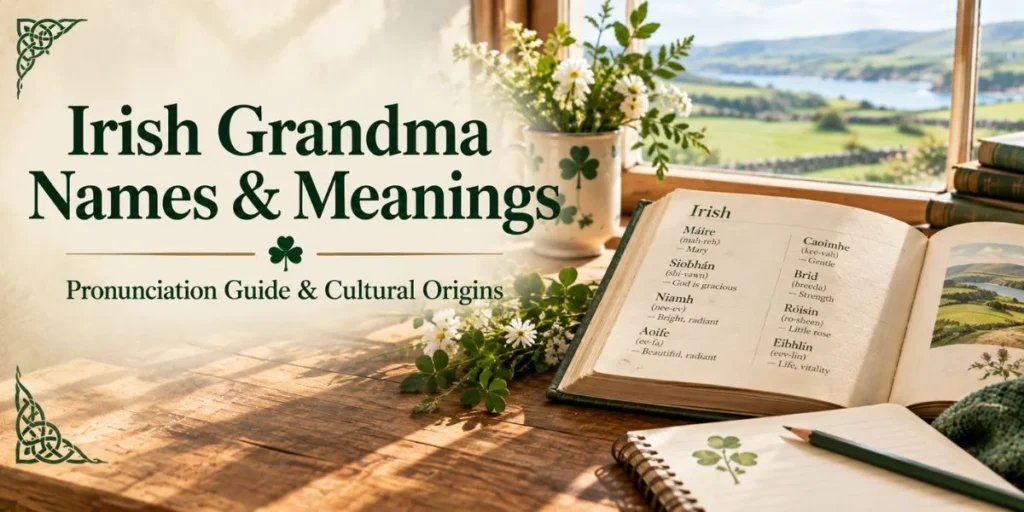
Irish spellings can look unfamiliar to English speakers, and pronunciation changes between dialects. The first four rows follow guidance from an Irish language blog, and the others are widely used approximations. They are not exact phonetic transcriptions, so check Foclóir.ie or another audio source before you settle on a name.
| Irish spelling | Pronunciation guide (approximate) | Meaning | Usage note |
|---|---|---|---|
| Seanmháthair | SHAN WAW hir | Grandmother | Formal term |
| Mamó | ma MOH | Grandma | Familiar term, stress on the second syllable |
| Móraí | MOR ee | Grandma | Familiar term, stress on the first syllable |
| Sinseanmháthair | SHIN SHAN WAW hir | Great grandmother | Formal term |
| Siobhán | shi VAWN | Irish form of Joan | Classic given name |
| Aoife | EE fa | Often explained as beauty | Legendary name |
| Niamh | NEEV | Bright or radiant | Soft sounding name |
| Caoimhe | KEE va | Gentle or precious | Modern name |
| Saoirse | SEER sha | Freedom | Pronunciation varies by region |
| Róisín | ro SHEEN | Little rose | Floral name |
| Aisling | ASH ling | Dream or vision | Modern name |
| Gráinne | GRAWN ya | Often linked to grain | Legendary name |
| Sinéad | shi NAYD | Irish form of Janet | Classic given name |
| Orlaith | OR la | Golden princess | Distinctive name |
| Fiadh | FEE a | Deer or wild | Distinctive name |
How to Choose the Right Irish Grandma Name?
Choosing a name is personal, and the best answer depends on the grandmother, the family, and the grandchildren who will say it every day. The guidance below helps you narrow the options without losing the warmth of the choice.
Consider Your Family’s Irish Heritage
Family history can guide a meaningful choice. A name that reflects a grandmother’s home county, a family surname, or a relative who emigrated can carry real emotional weight. Talking with older relatives may also reveal names the family already used.
Check the Meaning and Pronunciation
Irish spellings and meanings are easy to get wrong, so confirm them before you commit. A dictionary entry and an audio recording can prevent mistakes that might embarrass the family. A quick check is usually enough to settle any doubt.
Choose a Name That Feels Natural
A good name should be easy for the whole family to say, including very young children. Names that need constant correction can become tiring, while simple ones tend to fit naturally into daily life. If you want more ideas beyond Irish options, NameZel’s name generators tool can help you explore other styles.
Ask the Grandmother What She Prefers
The grandmother’s own preference matters most. Some women love a traditional title, while others would rather have a nickname that the grandchildren invented themselves. Asking her directly often leads to the happiest answer.
Distinguish Traditional Titles From Personal Nicknames
An authentic Irish term connects a family to the language, while a nickname connects it to shared affection. Many families use both, such as a formal term for special occasions and a playful nickname for everyday life. Five practical tips can help.
- Pick one main title so the grandchildren learn it clearly.
- Write down what each name means and how it sounds, and keep the note somewhere safe.
- Let the youngest children suggest nicknames, since they often invent the sweetest ones.
- Say the name aloud for a week before you decide.
- Keep the grandmother’s wishes at the center of every choice.
Frequently Asked Questions
These quick answers cover the questions readers ask most often. Each one stays brief, and the sections above hold the fuller detail.
What Is the Irish Word for Grandma?
The standard Irish word for grandmother is seanmháthair, and the familiar words are mamó and móraí. You can confirm spellings in the Foclóir.ie dictionary.
What Is the Most Common Irish Name for Grandma?
No reliable usage count exists, so the safest answer is that language sources most often describe mamó as the typical affectionate word. Many Irish families also simply use English titles such as Granny or Nana.
How Do You Pronounce Seanmháthair?
An approximate guide is SHAN WAW hir, but dialects differ. Listening to an audio recording is the most reliable way to learn it.
What Does Mamó Mean in Irish?
Mamó means grandma or granny and is a familiar, affectionate term. Children typically use it when speaking to their grandmother.
Are Irish Grandma Names Different Across Regions?
Spellings and pronunciations of some words can vary by dialect, such as mamó and maimeó. The words themselves are understood across Ireland, so local advice is helpful for fine detail.
What Is a Cute Irish Nickname for Grandma?
Mamó and móraí are the familiar Irish choices. Invented nicknames such as Shamrock or Sunbeam are family created, so they are charming additions but not Irish words.
What Is the Irish Word for Great Grandma?
The usual word is sinseanmháthair. It builds on the word for grandmother, so check the spelling and sound when you use it.
Can You Use an Irish Grandma Name Without Speaking Irish?
Yes, many families use Irish words without speaking the language fluently. Learning the correct spelling and sound shows respect and keeps the name true to its roots.
Conclusion
Irish grandma names cover a wide and lovely range, from the formal seanmháthair to the affectionate mamó and móraí, and from English family titles to classic given names and playful nicknames. Each kind has its own history, sound, and purpose, and knowing the difference makes the choice clearer. The best name is often the one with a story behind it that the family wants to keep telling.
When you choose, think about meaning, pronunciation, cultural accuracy, and what the grandmother herself would enjoy. Check each Irish word against a reliable source, say it aloud, and let her preference guide the final decision. A name chosen with care will carry its warmth for many years to come.
I am Emma Carter, a naming and branding writer at Namezel.
I help readers find business names, brand names, and creative name ideas across categories like gaming, baby names, and pet names.
My goal is simple: turn “what should I call this” into a name you’ll actually love.